|
<bgsound src="http://4jilr109.com/katrina2/katrina2.wmv" loop="10">
Just click the play button give it a
few seconds to load. |
|---|
Hurricane Rita
GALVESTON, Texas Although Hurricane Rita was downgraded to a Category 4 storm Thursday afternoon as it swirled toward the Gulf Coast with sustained winds measured at 150 mph, more than 1.3 million residents are fleeing Texas and Louisiana. "It's not worth staying here," said Celia Martinez as she and several relatives finished packing up their homes and pets to head to Houston. "Life is more important than things." An estimated 1.8 million residents or more in Texas and Louisiana were under orders to evacuate to avoid a deadly repeat of Hurricane Katrina . Traffic on some of Texas' main arteries was at a virtual standstill Thursday morning as people tried to move inland from the coastal areas. Drivers ran out of gas in 14-hour jams or looked in vain for a place to stay as hotels hundreds of miles in from the coast filled up. Others got tired of waiting in traffic and turned around and went home. Texas authorities were to begin airlifting at least 9,000 people from Beaumont and Houston, including nursing home residents, those without transportation and the homeless, to inland Texas cities. Military troops in South Texas also started moving north and schools, businesses and universities were closed. "This is a big, dangerous storm. It's a massive storm. It covers half of the Gulf of Mexico. It is still very unpredictable," said R. David Paulison, acting director of the Federal Emergency Management Agency , in a news conference Thursday afternoon. But preparations were going smoothly, he added. "The evacuations are going very well," Paulison said. "We still feel we have plenty of time to get those people out of harm's way before this storm makes landfall sometime tomorrow." As Texas Gov. Rick Perry urged residents along the state's entire coast to begin evacuating well in advance of Rita's predicted Saturday landfall, outer bands of rain began lashing New Orleans on Thursday, the first rainfall since Hurricane Katrina, raising fears that the patched-up levee system could fail and swamp the below-sea-level city all over again. "I've never seen a storm like this. This is worse than, it looks like it's worse than even Katrina," House Majority Leader Tom DeLay of Texas, who lives 45 miles in from the coast in Sugarland, told FOX News Thursday morning.
Black Leaders Focus on Katrina, Race and Poverty
We are moved by the grief and loss caused by Hurricane Katrina," said CBC chairman, Rep. Melvin L. Watt , D-N.C. In opening remarks on Wednesday, Watt said the caucus wants to show solidarity with the victims "and show that we are working for them." Scratching some business items from the original agenda, Watt and other members of the CBC set priorities of the 35th annual conference around storm relief and preparation, race and poverty issues. The Congressional Black Caucus is made up of the House and Senate's African-American members. The foundation is the fundraising arm of the caucus. Watt said he believed race was a factor in the number of people displaced and the slow response to the devastation caused by Hurricane Katrina, but that blacks were disproportionately hurt not because of their race but because they "didn't have the means to get away from this disaster." Watt said he wanted to dispel the misconception that the CBC had linked the federal government's slow response to the race of the overwhelming number of people left helpless by the storm. "They didn't have the cars, the gas, the locations where they could relocate to, the money to afford hotel rooms or to move away from that disaster. But that's true in every day life also. Poor people, disproportionately African-Americans, Hispanics, Asian-Americans
have little capacity to get away from bad things," he said. President Bush has similarly acknowledged that racial disparities set the stage for the problems left by Katrina, and White House spokeswoman Dana Perino said Wednesday afternoon that the Bush administration is committed to helping all people who were affected. "Hurricane Katrina did not discriminate in its destructive path and the response did not discriminate either," Perino told FOXNews.com. "The federal government is committed to helping all victims of the hurricane, and the president is working with Congress to develop new initiatives that will help the Gulf Coast region get back on its feet and help those who are in the greatest need of assistance." At the conference, Watt said that minorities who disproportionately face problems with health care, education and job opportunities are among the issues that the caucus was planning to address this week through forums, meetings and other events. Rep. Sheila Jackson Lee , D-Texas, said opportunities are to be found in the "horrible, unspeakable tragedy" resulting from the hurricane, including more attention to the issue of poverty, voting reform and administrative policy. For instance, she said, "We need to make sure that FEMA has the resources and the leadership" to respond correctly to future disasters. Officials made a number of other storm-related announcements at the conference, which is being held at the Washington Convention Center. The foundation's spokeswoman, Patty Rice, estimated that 1,500-2,000 guests attended the conference on Wednesday, usually the lightest day on the schedule. She said the conference averages 20,000 visitors annually. The Congressional Black Caucus Foundation has established a $1 million fundraising goal that will help in the hurricane relief effort. General Mills contributed a $100,000 to the drive. The caucus also held a candlelight vigil on the Capitol's west lawn Wednesday night to honor storm survivors, and several other storm-related discussions were set into the schedule throughout the week. Euclid Walker, a 33-year-old businessman from Chicago, said Katrina was on the tip of everyone's lips. With business interests of his own, he said he would like to see some more specific discussions about how the relief effort will enroll minority businesses. The Bush administration has suspended some minority business rules. "There are all these constraints in place," Walker said. Velma Charles-Shannon said she's been coming to the conference for the last 10 years. She works in the Agriculture Department's outreach office, managing a program that aims to make sure citizens have equal access to environmental programs offered by the USDA. She said she expects to have a lot of work as a result of the hurricane she works closely with the Environmental Protection Agency and hopes to get a few tips on how to better handle the crisis from a discussion set for Friday. "You listen, sometimes, you come away with a wider view of the world," Charles-Shannon said.
Faith Community Church donates
 Faith Community Church donates $100,000 HOLD ON FAITH CHURCH IS ON THE WAY TOO!... Faith Community Church1211 E Badillo St West Covina, CA 91790 Click here to see this touching video of Dr. Jim Reeve handing the donation check to Pastors Tommy and Matthew Barnett of the Dream CenterFaith Community Church donates $100,000 to the Dream Center's New Orleans "Emergency" relief program! Yes, the guy in the middle is the Pastor Jim Reeves, He's down with Jesus. Amen Thank you Faith Community! You went above and beyond to support the families and victims of Katrina. Through your generosity we are helping the Dream Center change lives by accommodating, feeding and caring for 300 families for up to 6 months. to help The Dream Center's New Orleans "Emergency" relief program . The Dream Center
Dream Center Bellevue Ave Los Angeles, CA 90026 KEEP THE FAITH !
Could it be GOD ?
At 33 percent, hurricanes top the list of natural disasters most likely to keep people from living in a certain area of the country, followed by earthquakes (26 percent), tornadoes (14 percent) and floods (12 percent). Some blame global warming for Katrina’s extraordinary strength (22 percent), however more than half (56 percent) think the storm’s power was more likely a random act of nature. A sizable 40 percent minority believes natural disasters are messages from a higher being, but just over half disagree (51 percent).Hmmm 22 %Do you think they know about the book of revelations too?. In His Name Amen!
A PROCLAMATION
National Day of Prayer and Remembrance for the Victims of Hurricane Katrina
The White House - Office of the Press Secretary
09/08/2005
BY THE PRESIDENT OF THE UNITED STATES OF AMERICA
A PROCLAMATION
Hurricane Katrina was one of the worst natural disasters in our Nation's history and has caused unimaginable devastation and heartbreak throughout the Gulf Coast Region. A vast coastline of towns and communities has been decimated. Many lives have been lost, and hundreds of thousands of our fellow Americans are suffering great hardship. To honor the memory of those who lost their lives, to provide comfort and strength to the families of the victims, and to help ease the burden of the survivors, I call upon all Americans to pray to Almighty God and to perform acts of service.
As we observe a National Day of Prayer and Remembrance for the Victims of Hurricane Katrina, we pledge our support for those who have been injured and for the communities that are struggling to rebuild. We offer thanks to God for the goodness and generosity of so many Americans who have come together to provide relief and bring hope to fellow citizens in need. Our Nation is united in compassion for the victims and in resolve to overcome the tremendous loss that has come to America. We will strive together in this effort, and we will prevail through perseverance and prayer.
Americans are reaching out to those who suffer by opening their hearts, homes, and communities. Their actions demonstrate the greatest compassion one person may show to another: to love your neighbor as yourself. Across our Nation, so many selfless deeds reflect the promise of the Scripture: "For I was hungry and you gave Me food; I was thirsty and you gave Me drink; I was a stranger and you took Me in." I encourage all Americans to respond with acts of kindness in the days ahead. By contributing time, money, or needed goods to a relief organization and by praying for the survivors and those in recovery efforts, we can make a tremendous difference in the lives of those in need.
Hurricane Katrina and its aftermath resulted in a considerable loss of life. We pray that God will bless the souls of the lost, and that He will comfort their families and friends and all lives touched by this disaster. As the American people unite to help those who are hurting, we share a determination to stand by those affected by Hurricane Katrina in the months and years ahead as they rebuild their lives and reclaim their future. We are determined that the Gulf Coast region will rise again. The tasks before us are enormous, and so is the heart of America. We will continue to comfort and care for the survivors. We will once again show the world that the worst adversities bring out the best in the American people.
NOW, THEREFORE, I, GEORGE W. BUSH, President of the United States of America, by virtue of the authority vested in me by the Constitution and laws of the United States, do hereby proclaim Friday, September 16, 2005, as a National Day of Prayer and Remembrance for the Victims of Hurricane Katrina. I ask that the people of the United States and places of worship mark this National Day of Prayer and Remembrance with memorial services and other appropriate observances. I also encourage all Americans to remember those who have suffered in the disaster by offering prayers and giving their hearts and homes for those who now, more than ever, need our compassion and our support.
IN WITNESS WHEREOF, I have hereunto set my hand this eighth day of September, in the year of our Lord two thousand five, and of the Independence of the United States of America the two hundred and thirtieth.
GEORGE W. BUSH
###
Katrina Reveals Poverty Reality
| Katrina Reveals Poverty Reality | | Friday, September 09, 2005 By Kelley Beaucar Vlahos Stories of the grinding poverty among the survivors of Hurricane Katrina in New Orleans vividly illustrate what many say is a forgotten truth of modern American life that pockets of desperate poverty still exist in a country of unsurpassed wealth and privilege. Underscoring that reality, a report by the U.S. Census Bureau released the same week Katrina hit the nation's southeast announced that the national poverty rate rose for the fourth straight year despite continuing growth in production and political rhetoric that the nation's economy is on the upswing. Click here to read the U.S. Census Bureau's report. According to that report, the number of Americans living under the poverty line grew by 1.1 million in 2004 for a total of 37 million people nationwide. That equals 12.7 percent of the total U.S. population. It is the fourth annual increase. "[Poverty] is a problem in America that hasn't gone away it just went underground for a while, and it shouldn't have," said Sheila Zedlewski, director of the Urban Institute's Income and Benefits Policy Center. Through images of the predominantly black residents of New Orleans pleading for help, leaving destroyed homes with nothing but the clothes on their backs, America got a wake-up call according to Sheldon Danziger at the National Poverty Center at the University of Michigan. | "People are putting these things together, and it will be interesting to see if the attention of the public stays on this," he said. "As a country we'd like to think we moved beyond it, but in reality, [poverty] is still a substantial problem." Others caution against putting too much weight into the new numbers, pointing out that they do not reflect the public assistance low-income individuals and families receive, like Medicaid and welfare, and do not distinguished between truly impoverished individuals and those who are temporarily poor. The poverty rate began to climb in 2000, the year it hit a 26-year low of 11.3 percent of Americans living under the poverty level, according to U.S Census Bureau figures. That was the lowest point since 1974, when the number was 11.2 percent. The highest point of poverty in recent times was in 1993 at 15.1 percent. Before that, was in 1983, at 15.2 percent. In 2004, according to the latest study, the poverty rate among African Americans remained the same at 24.7 percent. Hispanics also saw no change in their poverty rate at 21.9, while whites saw an increase, from 8.2 percent to 8.6 percent. Asian Americans experienced the only decrease, from 11.8 percent to 9.8 percent. The poverty rate among American families remained at 10.2 percent of the population in 2004. The Office of Budget and Management defines a family of two adults and two children with a median household income of $19,157 or less as living in poverty; or a family of two with no children, making $12,649 a year. Median household income went unchanged in 2004, according to the census bureau, at $44,389. Blacks continue to have the lowest median income among all ethnic and racial groups, making $30,134 annually. Wages earned among Americans, however, declined in 2004. For men over 15 working full-time, year round, the real median earnings declined 2.3 percent from 2003, to $40,798. For women with similar work experiences, wages declined by 1 percent to $31,223. And while unemployment has gone down from 5.5 percent in August 2004 to 4.9 percent in August this year, unemployment among blacks is still the highest in the country, at 9.6 percent in August compared to 4.2 percent for whites and 5.8 for Hispanics. In New Orleans, where blacks make up 67 percent of the population, 27 percent of the residents are living below poverty level according to a recent study by Total Community Action, Inc., a public advocacy group based in New Orleans. Click here to read that study. But some warn that the new census bureau figures may not be an ideal measure, given that they do not take into account the impact of public assistance on a household, or recent tax cuts and child tax credits. Others say the poverty rate had been in steady decline since the early 1990's and see the recent increases as the tail end of the 2000 recession. "It's a bit unfortunate to link the hurricane with the issue of poverty in this country," as though there has been no reduction in poverty since the 1980's, said Rey Hederman, senior policy analyst for the Heritage Foundation. Since a high point in 1983 the poverty rate for the U.S has been on a decline, aside from the four years following the brief recession in 1989 and the most recent hike, according to the Census Bureau. Like other economic analysts, Hederman believes the growth in productivity in the U.S economy will eventually produce more jobs and higher incomes for workers. But so far, Hederman admits, that hasn't happened. "We've got strong productive growth but wages have been relatively stagnant. It's a bit of a paradox as to why it hasn't happened sooner," said Phillip Swagel of the American Enterprise Institute, who blames, in part, the Internet bust six years ago. Nonetheless, he calls today's economy "the most golden era for productivity growth" in more than 50 years. "In the short term, it means that firms have been able to produce more without hiring more people," Swagel continued. "But in the long term, it will mean that wages and income will go up. It takes time for that relationship to take hold." But on Wednesday, the Congressional Budget Office announced that hurricane's damage to the southeast could reduce national economic growth by nearly a percent at time when forecasters were hoping for a three to four percent increase by the end of the year. It also expects a loss of 400,000 jobs in the labor market. Some say that inner cities that have never fully recovered from past economic recessions will no doubt be the hardest hit. "I think for the last 25 years, we have had an economy where most of the gains have been concentrated in a small percentage of the workforce," said Danziger. "[The] rising tide has not lifted all boats, the economy has shifted so that a smaller portion of the population gets the increases, and the rest is simply happy to have jobs that experience no wage increase or income increases." According to the recent Total Community Action study, poverty rates have remained stagnant in New Orleans in the last 40 years and even without the near total destruction of the city, have been the highest in the nation. "It would be ironic that it would take a disaster like this to focus [national attention] on this," Rep. Mel Watt, R-N.C., and member of the Congressional Black Caucus , told FOXNews.com, "Every area of our lives these disparities exist and we have tried to focus on them all year." Minority populations left behind in many cities often suffer from bad schools and are at a real disadvantage compared to their suburban middle class and affluent counterparts, say experts. "The poverty differences by education, by race, by central city versus the suburbs, are long standing," said Danziger, who also said that by leaving New Orleans' most disadvantaged, immobile residents behind the hurricane "clearly brought that into stark contrast." The Urban Institutes Zedlewski admits that over the last several years more resources have been focused on the symptoms of poverty poor education and healthcare. "If you look at the long haul it is true progress has been made," she said, adding that more needs to be done, particularly in the African American community, regarding single motherhood, the high rate of incarcerated males and investing in adult education. Swagel, who recently left his job as chief of staff for the White House Council of Economic Advisors , believes the current administration has put into place policies notably tax cuts that have stimulated growth and are benefiting middle and lower income families the most. "I would say our policies are on the right track," he said. "They are working in the right direction, and we should not reverse course when things are improving." Watt doesn't buy the tax cut stimulus scenario. "As soon as this President came in and passing these massive tax cuts, [the poverty rate] turned and went in the opposite direction," he said. "This administration is about supporting people of higher income and it makes no bones about it." Meanwhile, thousands of displaced people from New Orleans are looking for jobs, and trying to begin new lives in places like Houston and Baton Rouge. Poverty advocates hope that in the long term, available education and job training opportunities, as well as the higher wages that have been promised by economists, aren't out of reach.
Pledge in Schools Unconstitutional
Federal Judge Rules Reciting Pledge in Schools Unconstitutional | Wednesday, September 14, 2005 SAN FRANCISCO -
A federal judge ruled Wednesday that reciting the Pledge of Allegiance in public schools was unconstitutional. U.S. District Judge Lawrence Karlton ruled that the pledge's reference to one nation "under God" violates school children's right to be "free from a coercive requirement to affirm God." The judge has granted legal standing to two families represented by an atheist who lost his previous battle before the U.S. Supreme Court. Karlton said he was bound by precedent of the 9th U.S. Circuit Court of Appeals, which in 2002 ruled in favor of Sacramento atheist 
Michael Newdow that the pledge is unconstitutional when recited in public schools. "Imagine every morning if the teachers had the children stand up, place their hands over their hearts, and say, 'We are one nation that denies God exists,"' Newdow said in an interview with AP Radio after the ruling. "I think that everybody would not be sitting here saying, 'Oh, what harm is that.' They'd be furious. And that's exactly what goes on against atheists. And it shouldn't." |
SEPTEMBER 16 2005 NATIONAL DAY OF PRAYER
Throughout our history in times of testing, Americans have come together in prayer to heal and ask for strength for the tasks ahead. So I've declared Friday, September the 16th, as a National Day of Prayer and Remembrance. I ask that we pray -- as Americans have always prayed in times of trial -- with confidence in His purpose, with hope for a brighter future, and with the humility to ask God to keep us strong so that we can better serve our brothers and sisters in need.
--George W. Bush
Presidential Prayer Team Join Us

The Presidential Prayer Team
UPDATED PRAYER POINTS FOR HURRICANE KATRINA
The nation has been stunned by the huge scale of devastation brought by Hurricane Katrina. As Christians, we know we have the most profound and reliable resource with which to deal with the crisis—our faith in God, and our reliance on prayer.
Please distribute the following prayer requests to your church, Bible Study group,
prayer chain or email list. These needs are great, and your prayers will make a meaningful difference. God will be glorified as we pray For: ~~~~~~~
Wisdom for the President, members of his cabinet, state and local officials as they respond to the needs that remain in the Gulf Coast—especially in New Orleans. ~~~~~~~
Health and strength for evacuees as they continue to live under difficult conditions, not knowing when they may return to their homes if ever. ~~~~~~~
Protection, health and strength for relief and rescue workers who continue to work in dangerous areas under threat of disease and infection. ~~~~~~~
Comfort and consolation for those who have lost loved ones and those whose loved ones are missing. ~~~~~~~
Continued miraculous reunion of family members. ~~~~~~~
Provision of all needs, including spiritual and emotional support as well as jobs and housing, for evacuees who are now spread out across the nation. ~~~~~~~
Restoration of electricity and water supplies, willingness to conserve by all. ~~~~~~~
Cooperation on the part of those who must now evacuate by order of the mayor of New Orleans. ~~~~~~~
Do not be anxious about anything, but in everything, by prayer and petition, with thanksgiving, present your requests to God. And the peace of God, which transcends all understanding, will guard your hearts and your minds in Christ Jesus.
--Philippians 4:6-7
LEFT BEHIND
THIS SHOULD ANSWER THE QUESTION... WHY DIDN'T THEY JUST LEAVE ?. NEW YORK People living in the path of Hurricane Katrina's worst devastation were twice as likely as most Americans to be poor and without a car factors that may help explain why so many failed to evacuate as the storm approached. An Associated Press analysis of Census data shows that the residents in the three dozen hardest-hit neighborhoods in Louisiana, Mississippi and Alabama also were disproportionately minority and had incomes $10,000 below the national average. "Let them know we're not bums. We have houses. Our houses were destroyed. We have jobs. It's not our fault that we didn't have cars to leave," Shatonia Thomas, 27, said as she walked near New Orleans' convention center five days after the storm, still trapped in the destruction with her children, ages 6 and 9. Money and transportation two keys to surviving a natural disaster were inaccessible for many who got left behind in the Gulf region's worst squalor. "It's a different equation for poor people," explained Dan Carter, a University of South Carolina historian. "There's a certain ease of transportation and funds that the middle class in this country takes for granted." Catina Miller, a 32-year-old grocery deli worker who lived in the Ninth Ward, a poverty-stricken New Orleans enclave created in the 1870s by immigrants who were too poor to find higher ground, said she certainly would have liked to have left the city before the hurricane hit. "But where can you go if you don't have a car?" she asked. "Not everyone can just pick up and take off." Jack Harrald, director of the Institute for Crisis, Disaster and Risk Management at George Washington University in Washington, said emergency planners have known for years that the poverty and lack of transportation in New Orleans would be a significant problem, but the government spent more time and money preparing itself rather than communities for disaster. "All issues were known," said Harrald, whose institute had been scheduling a series of emergency planning community meetings through a partnership with the University of New Orleans. "But it was still a work in progress. ... There's enough blame to go around for everybody." The AP analysis showed: Median household income in the most devastated neighborhood was $32,000, or $10,000 less than the national average. Two in 10 households in the disaster area had no car, compared with 1 in 10 in nationwide. Nearly 25 percent of those living in the hardest-hit areas were below the poverty line, about double the national average. About 4.5 percent in the disaster area received public assistance; nationwide, the number was about 3.5 percent. About 60 percent of the 700,000 people in the three dozen neighborhoods were minority. Nationwide, about 1 in 3 Americans is a racial minority. One in 200 American households doesn't have adequate plumbing. One in 100 households in the most affected areas didn't have decent plumbing, which, according to the Census, includes running hot and cold water, a shower or bath and an indoor toilet. Nationwide, about 7 percent of households with children are headed by a single mother. In the three dozen neighborhoods, 12 percent were single-mother households. "It's the same people who don't have the wherewithal to get out of Dodge," explained National Guard Lt. Col. Connie McNabb, who was running a medical unit at the besieged convention center in New Orleans. The disparities were even more glaring in large, urban areas. One of the worst-hit neighborhoods in the heart of New Orleans, for example, had a median household income of less than $7,500. Nearly three of every four residents fell below the poverty line, and barely 1 in 3 people had a car. "I didn't have much in there," said Deanna Harris, a 57-year-old unemployed New Orleans resident, "but it was mine. "Now, this is what I've got," she said, patting a plastic bag. The hardest hit victims of Mississippi have much the same story. In one Pascagoula neighborhood, where 30 percent of residents are minorities, more than 20 percent live in poverty. In Alabama, where Katrina wasn't as severe, one of the hardest hit areas was a downtown Mobile neighborhood, where the median household income is barely $25,000 and one of every four residents lives below the poverty line. "There's not a lot of interest in this issue, except when there's something dramatic," said Carter, the South Carolina historian. "By and large, the poor are simply out of sight, out of mind."
California Rocks The Best Story yet
THIS MAN AMONG MEN RENTED A LEAR JET TO HELP GET PEOPLE OUTAMAZING NOW THIS IS WHAT DERLESU CALLS "SHOCK AND AWE"THERE AREN'T ENOUGH WORDS TOEXPRESS THIS AWESOME EXPRESIONOF THIS MAN'S ANGER AND RAGE AND DISSAPOINTMENT IN OUR GOVERNMENT . DAVID FOR "CHIEFHOMELAND SECURITY OFFICER".David gets our vote for the best "GOOD SAMARITAN AWARD" Awesome MAN David Perez has spent $200,000 rescuing victims of Hurricane Katrina. He said saving just one life is "worth a million dollars." 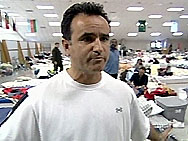 Fed up with what he says is the government's slow response in rescuing residents along the hurricane-ravaged Gulf Coast, a California businessman is taking action. Over the weekend, David Perez launched an effort to evacuate New Orleans — on his own. Using $200,000, Perez chartered a Boeing 737. Upon landing in Louisiana, he unloaded much-needed supplies he had purchased at a local Costco and later reloaded the plane with 86 weary hurricane victims. "These people need to have their kids in school and get their feet back on the ground," Perez said. "They have gone through devastation." The group headed to San Diego, where Perez has organized a contingent of local families to open up their hearts and homes as temporary shelters. Welcome Relief Perez's efforts are greatly appreciated by those who have lost everything. "I don't have nowhere else to go," said hurricane victim Norman Chatman. "I'm looking for a new start, a new beginning." Perez said he's just doing what the government failed to do to help victims of Hurricane Katrina. "It's a joke," he said. "Everyone took a vacation from this disaster." Perez was there for every step of the journey, handing out boarding passes and helping with luggage. When the plane touched down in San Diego, tears of devastation finally turned to tears of joy. As chairman and chief operating officer of Carmel Valley-based Surge Global Energy, Perez said he's counting on one of the company's drilling operations to pay his credit card bills for the relief effort — or else he will have to take out a second mortgage on his San Diego home. If all goes well, he might arrange for additional evacuation flights. "If I save one life — just one life — and I make one person's life better on this trip," he said, "it's worth a million dollars to me."
SHUT UP Katrina Food For Thought
If you aren't part of the solution (helping like never before) then you are apart of the problem so move out of the way... and let us who are DOING IT WORK. THIS ISN'T BUSINESS AS USUAL WHAT IF IT WERE YOU AND YOUR'S? SO SHUT UP AND RUN AWAY WE DON'T NEED YOU !! Ask yourself the question of "would you run" after you read this!!! Would you run?
Imagine this happening to you...
One Sunday morning during ! service, a 2,000 member congregation
was surprised to see two men enter, both covered from head to toe in
black and carrying submachine guns.
One of the men proclaimed,
"Anyone willing to take a bullet for Christ remain where you are."
Immediately, the choir fled...the deacons fled...and most of the congregation fled....
Out of the 2,000 there only remained around 20.
The man who had spoken took off his hood...
He then looked at the preacher! and said " Okay Pastor, I got rid
of all the hypocrites... Now you may begin your service. Have a nice day!"
And the two men turned and walked out.
Fed up with hearing about agonizingly slow efforts to get relief to the victims of Hurricane Katrina, San Diego businessman David Perez chartered JET
Fed up with hearing about agonizingly slow efforts to get relief to the victims of Hurricane Katrina, San Diego businessman David Perez chartered a Lear jet from Carlsbad, Calif., to Baton Rouge on Saturday morning. He brought with him outrage, a few members of the media, a few bags of relief supplies and promises to do much more for the still-suffering victims of the nation's worst natural disaster.Perez said he plans to bring another chartered jet, this one full of storm victims, Sunday to San Diego, where dozens of families have offered their homes as temporary shelter. But the oil executive and his rogue mercy mission got off to a difficult start Saturday. Perez barked pleas and orders into his cell phone in the lobby of Carlsbad's McClellan-Palomar Airport, making frantic phone calls before departing at 9:45 a.m. Saturday."I need a tanker of gas to the Baton Rouge Sheriff's Department!" he told his assistant, Ryan Lipkovacious, while scribbling notes outside the airport lobby. "They're all out of fuel! Their SWAT team can't move!"Perez pledged Friday to pay to fly relief supplies to Louisiana and to bring evacuees back to San Diego County. Frustrated at the slow pace of the relief efforts he had seen on television, the oil company executive contacted Jewish philanthropic organizations looking to donate to the effort.But he said that when National Guard officials couldn't tell him who was in charge, he decided to get much more personally involved. Frenetically working his cell phone Saturday morning, Perez juggled calls to emergency managers, state senators and hospital officials in Louisiana. He made calls to people around the country that he had enlisted to contribute to his wildcat relief effort.At times, his anger and lack of sleep came to a boil."FEMA never showed up," he told a few reporters at the Carlsbad airport, his voice rising. "How did I get these phone calls? Who am I? Why aren't they calling the government?"I'm out there looking for water, fuel, food ---- for publicly elected officials!" he seethed, before shouting into a TV camera: "Bush, get off your ass and get to work!"Then he and pilots for Executive Jet Services went to work, loading supplies Perez had bought at CostCo ---- tampons, toothbrushes, energy bars, bottled water and bandages and other essentials ---- onto the small private jet.Perez said he had already paid $100,000 toward the effort, but expected the total cost to rise to $250,000 if he fulfilled his pledge to bring 150 refugees back to San Diego County.After 23 years in telecommunications, Perez has served as chief operating officer at Carmel Valley-based Surge Global Energy for about a year.He said he was counting on one of his company's drilling operations to pay his credit card bills for the relief effort, or else he would have to take out a second mortgage on his San Diego home.But he was clearly not content with merely contributing money."Everybody wants money," he said. "They don't want food or help," he said. "But I don't want to give money and have it sit there. I'm on the ground to get food to the people."Perez, who upon landing in Baton Rouge talked his way onto a rescue helicopter that took him to New Orleans, later said he was working with the Louisiana Social Services Department to identify storm victims for the planned evacuation to San Diego.He said he planned to have a list of names of evacuees making the trip by late Saturday night, and that assistants in San Diego were coordinating housing for the storm victims.A local spokeswoman for the Red Cross, which did not sanction or ask for Perez's help, said Saturday that the Red Cross would be ready to assist with evacuees if they show up in San Diego.As of Saturday night, Perez had a jet with room for more than 150 evacuees chartered to leave from Baton Rouge Monday.Contact staff writer Denis Devine at (760) 740-5415 or ddevine@nctimes.com.
Heart Breaking Images
 Faith Crossing Church member Amanda Fowler, left, prays with evacuee Charleetha Lawrence at church in Texas. Leona Watts sits in her home of 61 years after surveying her belongings in Long Beach, Miss.  Sept. 4: Geese cross in front of a
New York Police Department
emergency vehicle in Waveland, Miss.
 Savannah Adkins, 6, sells lemonade outside her grandparents’ Oklahoma City home to raise money for victims. (Oklahoma Isn't it ironic? Remember the cities bombings there) Thank you Jesus hearts weren't hardened
Disaster Unemployment Assistance
Disaster Unemployment Assistance (DUA)
The Department of Labor is working with state and local governments in disaster areas and relief sites to issue unemployment insurance and disaster unemployment assistance. For more information, call 1-866-4-USA-DOL (1-866-487-2365) visit America's Service Locator. Visit www.dol.gov
If you need money go here Hurricane Recovery Assistance
President George W. Bush has declared major disasters for impacted areas in Louisiana, Mississippi, Florida, and Alabama. The U.S. Department of Labor is supporting efforts in these communities in coordination with the U.S. Department of Homeland Security, the agency that is actively managing federal assistance to these affected communities in an effort to expedite response efforts and save lives. The Department of Labor support includes the following: - National Emergency Grants (NEGs)
Impacted states can apply for NEG funds that can be used to temporarily employ dislocated workers. These funds can be used to employ workers on projects that provide food, clothing, shelter and other humanitarian assistance for disaster victims.
Learn how to apply for a National Emergency Grant. - Disaster Unemployment Assistance (DUA)
The Department of Labor is working with state and local governments in disaster areas and relief sites to issue unemployment insurance and disaster unemployment assistance. For more information, call 1-866-4-USA-DOL (1-866-487-2365) or visit America's Service Locator. - Employee Benefits Security Administration (EBSA)
EBSA is extending pension plan filing deadlines. Hurricane Katrina has proven to be one of the most dangerous storms in U.S. history. Hazards from weakened and damaged trees, downed power lines, high water, and other dangers remain. We urge citizens to be mindful of instructions from state and local officials who have asked that individuals remain in shelters, homes or safe places until given further notice. Individuals in declared counties can register online for disaster assistance at www.fema.gov or call FEMAs toll free registration line at 1-800-621-FEMA (3362); for the hearing impaired TTY 800-462-7585. - Hurricane Katrina
Deputy Assistant Secretary Jonathan Snare Version 1 [MP3] [WAV]
Deputy Assistant Secretary Jonathan Snare Version 2 [MP3] [WAV]
- Flooding
English: [MP3] [WAV]
Spanish: [MP3] [WAV]
- Electrical
English: [MP3] [WAV]
Spanish: [MP3] [WAV]
- Chainsaws
English: [MP3] [WAV]
Spanish: [MP3] [WAV]
- Falls
English: [MP3] [WAV]
Spanish: [MP3] [WAV]
- Mold
English: [MP3] [WAV]
Spanish: [MP3] [WAV]
Hurricane Recovery Assistance
A reporter is mad
I can't believe what I am hearing on television. A reporter is mad because there is a building on fire and there is no one from the fire department to put it out. Come on now. They have to make choices. Right now it's a choice between putting out a fire where no lives are in danger, or go out and help rescue people who are still trapped. NOPD and state police are doing the best they can. Some local websites are estimating that approximately 1,500 people are still stuck on roofs in St. Bernard parish. The police, firemen, EMTs, doctors, and others who are trying to rescue strangers, are truly some of the finest people in America. They are the only people who are courageous enough to stay and face danger. If you do research on New Orleans, you will see that it is a beautiful but very dangerous city, even prior to Katrina. There are some legit people who need help, but some are just taking advantage. What is happening in New Orleans is an embarrassment to everyone who is from that area. I expected better. It is a tough time, and everyone must ban together to help your neighbor out, not kill or rob them. Mayor Nagin of New Orleans is doing the best he can with what he has. It's not his fault. He is begging for help. We have to pull together. All we have left is each other.
Family evacuated New Orleans
I just heard from our friend Rob. He and his family evacuated New Orleans. They have eight feet of water in their home and an unknown amount of water at his business. He is en route to Monroe, Louisiana. He is trying to drop off his wife and kids with family. From there, he will head to Baton Rouge where they are trying to set up a temporary office. I talked to my husband very briefly. I hear the stress in his voice. I don't know what to do. Rob has also lost everything and only has $9 in his pocket. He has a wife and three children, all under the age of seven. My sister's friend is heading to Franklinton, LA to rescue her aunt and uncle. They called her stating that theyre trapped in their home by trees, with no water and food. Along with her husband, she left from Atlanta with chainsaws to try and get them help. My grandfather called. He got 13 feet of water in his house. It is a total loss. My cousin called. He and his family rode out the storm at my uncle's house. Their house is sitting on their neighbor's house. They have lost everything. They have three very young children. I can't sleep or eat. My mind just goes a mile a minute. I am scared. I am scared for my loved ones who are in Slidell. My daughter Britta asked me today when she is going home. She talks about her birthday party that all of her friends from school were going to come to. I still have not told her that she probably won't have a birthday party this year. Anyone reading this: Please stay away from Slidell. There is no food, water, or shelter. Conditions are very dangerous. Slidell police have run out of gas and are on foot. Its worse than you can imagine.
The dead and dying
Thousands more bedraggled refugees were bused and airlifted to salvation Saturday, leaving the heart of New Orleans to the dead and dying, the elderly and frail stranded too many days without food, water or medical care. No one knows how many were killed by Hurricane Katrina's floods and how many more succumbed waiting to be rescued. But the bodies were everywhere: hidden in attics, floating among the ruined city, crumpled on wheelchairs, abandoned on highways. The dying went on at the convention center and an airport triage center, where bodies were kept in a refrigerated truck.
U.S. Troops in Iraq, Afghanistan to Help With Katrina Relief
U.S. Troops in Iraq, Afghanistan to Help With Katrina Relief DUBAI, United Arab Emirates The U.S. Air Force will send 300 airmen home from Iraq and Afghanistan to help their families cope with emergencies on an air base devastated by Hurricane Katrina in Biloxi, Miss., a spokesman said Saturday. The airmen, all based at Keesler Air Force Base, will begin flying home over the next two weeks, said Air Force Capt. David Small, spokesman for U.S. Central Command Air Forces in Qatar . The group includes airmen who were scheduled to rotate home in September and others whose deployments will be cut short. "Those who weren't scheduled to go home, we're going to send them home anyway to take care of their families and the hurricane damage," Small said. Keesler, just off the beach in the Gulf Coast city of Biloxi , suffered a direct hit from the hurricane and much of its housing and other infrastructure were wiped out. Small said most personnel and families on the base had been moved to temporary shelters. "Everything was under water," he said. Master Sgt. James Riley, 39, said he only left Keesler six days ago for duty on the U.S.-run al-Udeid Air Base in Qatar. Now, Riley is finishing his paperwork to return to Mississippi. "I've been called back to assist with recovery efforts and to assist my family," said Riley, whose wife and three children have taken shelter in a school on the base. U.S. authorities want Keesler returned to operation to handle hurricane relief flights, Riley told The Associated Press. "It's going to be the heart, the pulse of the relief effort," Riley said. "We've got a vested interest in getting back there and getting things running. That's where our homes are, that's where our families are." The storm wiped out 90 percent of the homes on the base, with officers' quarters closest to the waterfront faring worst, Riley said. Small said he had heard no reports of storm-related deaths on the base. Keesler houses both active duty airmen and Air Force reservists. The decision to send Keesler-based airmen home was made by top Air Force officials with the support of Brig. Gen. Allen G. Peck, the deputy commander of coalition air forces in the Iraq and Afghanistan theaters. Peck is based at al-Udeid Air Base. Small said the 300 airmen will be leaving many bases in Iraq and Afghanistan as well as surrounding countries in Central Asia and Arab states of the Persian Gulf. Some will be flying home on commercial airlines, he said. Small said the Air Force would ensure the early departure would not damage the Air Force's war-fighting capabilities, which include ground attack sorties, cargo and fuel deliveries, air-to-air refueling and troop transport. "We're making sure the unit commanders here can still conduct their missions without the folks from Keesler," Small said. "There are about 18,000 airmen in the theater, so we can pick up the slack." A statement on Keesler's Web site described damage to the base as "severe enough that we are unable to leave our shelters until Thursday at the earliest." Base residents were waiting for recovery teams to clear debris and repair damage before Keesler would be reopened. Air Force personnel serve shorter, more frequent deployments in the war theaters than do U.S. Army and Marine forces. Air Force deployments average about four months but can extend to a year, Small said. By contrast, Army deployments last from 10 months to a year, and Marines are sent for about seven months. Keesler houses the U.S. Department of Defense's weather school, the Air Force's second-largest medical facility, and handles training in high-tech command-and-control and computer networking. U.S. military officials have said there are no plans for a large-scale shifting of U.S. troops from Afghanistan or Iraq to assist recovery efforts. The commander of the Louisiana National Guard's 256th Brigade Combat Team, based in Baghdad, had asked that his 3,700 soldiers be sent home a few weeks early to deal with the crisis. The 256th already was preparing to go home later this month when Katrina struck. Lt. Gen. John Vines, commander of Multi-National Corps-Iraq, said Friday that only U.S. troops whose family members were injured or killed by the hurricane may be allowed to go home early. Others will have to stay in Iraq and finish their missions, he said, otherwise remaining troops in Iraq would be at greater risk. Emergency leave is being handled on a case-by-case basis, said Lt. Col. Steve Boylan, a spokesman for the U.S. command in Baghdad. "We are not redeploying units/personnel for the hurricane relief efforts as all the units/personnel here are required for the ongoing security and stability operations happening here in Iraq," Boylan said in an e-mail message.
How you too can help NO EXCUSES
We have placed all the assistance infomation HERE there is no excuse for not helping there is something for everyone no matter what your situation. How to Help As the nation witnesses the aftermath of Hurricane Katrina, thousands are asking how they can help. 1. Pray without stoping anyone can do this : No emergency number or website needed JUST DO IT!. 24/7The American Red Cross is taking donations to help the thousands of victims at http://www.redcross.org/donate/donate.html. The Salvation Army is providing services for victims and first responders. Donate via the web at http://www.salvationarmyusa.org/USNSAHome.htm or call 1-800-SAL-ARMY. You can also make donations in person at your local Wal-Mart or Sam's Club. Following is a list of other Web sites offering disaster relief information: Military families needing assistance locating loved ones and finding support for their families should contact http://www.militaryonesource.com/or call 1-800-342-9647. Federal Emergency Management AgencyPhone: 1-800-621-FEMA http://www.fema.gov/Louisiana Homeland Security http://www.ohsep.louisiana.gov/City of New Orleans http://www.cityofno.com/portal.aspxLouisiana Governor's Office http://www.gov.state.la.us/Catholic CharitiesPhone: 1-800-919-9338 http://www.catholiccharitiesusa.org/FEMA Charity tips http://www.fema.gov/rrr/help2.shtmNational Voluntary Organizations Active in Disaster http://www.nvoad.org/Louisiana Society for the Prevention of Cruelty to Animals http://www.la-spca.org/National Voluntary Organizations Active in DisasterAnde Miller, Executive DirectorEmail: amiller@nvoad.orgPhone: 703-339-5596 For Patients in Need of Dialysis: Fresenius Medical Care North America Emergency Response Line: 1-800-626-1297 Fresenius Medical Care Emplpyee Emergency Line: 1-866-362-6256 x304 Local Red Cross contacts — American Red Cross - Southeast Louisiana Chapter: 2640 Canal St.New Orleans, LA 70119Phone: ( 504) 620-3105 or (800) 229-8191Fax: (504) 827-2135 http://www.arcno.org/?id=5&sub=3Regional Service Centers — NORTHSHORE REGION:Regional Office619 N. Tyler, Suite DCovington, LA 70433Phone: (985) 892-4317 Boothville, LA:Phone: (985) 534-7449 Slidell, LA:Phone: (985) 643-5608 Hammond, LA:Phone: (985) 542-3469 Bogalusa, LA:Phone: (985) 732-4227 BAYOU PARISHES REGION: Regional Office1231 Canal Blvd.Thibodaux, LA 70302Phone: (985) 447-3229 (Mail to: P.O. Box 102, Thibodaux, LA 70302) Houma, LA:Phone: (985) 872-6584 RIVER PARISHES REGION: 107 Maryland Dr., Suite D and ELuling, LA 70070Phone: (985) 785-0647 LaPlace, LAPhone: (985) 652-9963 American Red Cross - Northwest Louisiana Chapter4221 Linwood AvenueShreveport, LA 71108Phone: (318) 865-9545Fax: (318) 868-4111Email: redcross@louisianaredcross.orghttp://www.louisianaredcross.org/Red Cross Disaster Assistance info: (866) GET-INFO (866-438-4636) http://www.redcross.org/contactus/FEMA Regional Offices — http://www.fema.gov/regions/FEMA Region IV(Alabama, Florida, Georgia, Kentucky, Mississippi, North Carolina, South Carolina and Tennessee)3003 Chamblee-Tucker Rd.Atlanta, GA 30341Phone: (770) 220-5200 FEMA Region VI(Arkansas, Louisiana, New Mexico, Oklahoma and Texas)Federal Regional Center800 N. Loop 288Denton, Texas 76209Phone: (940) 898-5399 State Emergency Organizations: FEMA State Emergency Contact — http://www.fema.gov/fema/statedr.shtmAlabama Department of Public SafetyPhone: (334) 242-4445Website: http://www.dps.state.al.us/Alabama Emergency Management Agency5898 County Road 41P.O. Drawer 2160Clanton, Alabama 35046-2160Phone: 205-280-2200Fax: 205-280-2495Website: http://www.ema.alabama.gov/Florida Division of Emergency Management2555 Shumard Oak Blvd.Tallahassee, Florida 32399-2100Phone: 850-413-9900Email: florida.disaster@dca.state.fl.usWebsite: http://www.floridadisaster.org/Florida Emergency Preparedness AssociationPhone: 850-906-0779Fax: 850-893-1845Email: fepa@fepa.orgWebsite: http://www.fepa.org/Louisiana Office of Homeland Security and Emergency PreparednessPhone: 225-925-7500Fax: 225-925-7501Website: http://www.ohsep.louisiana.gov/Louisiana Office of Emergency Preparedness7667 Independence Blvd.Baton Rouge, Louisiana 70806Phone: (225) 925-7500Fax: (225) 925-7501 http://www.loep.state.la.us/Mississippi Emergency Management AgencyP.O. Box 4501 - Fondren StationJackson, Mississippi 39296-4501Phone: (601) 352-9100Toll Free Phone: (800) 442-6362Fax: (601) 352-8314 Georgia Emergency Management AgencyP.O. Box 18055Atlanta, Georgia 30316-0055Phone: (404) 635-7000Fax: (404) 635-7205 http://www.State.Ga.US/GEMA/
|


